
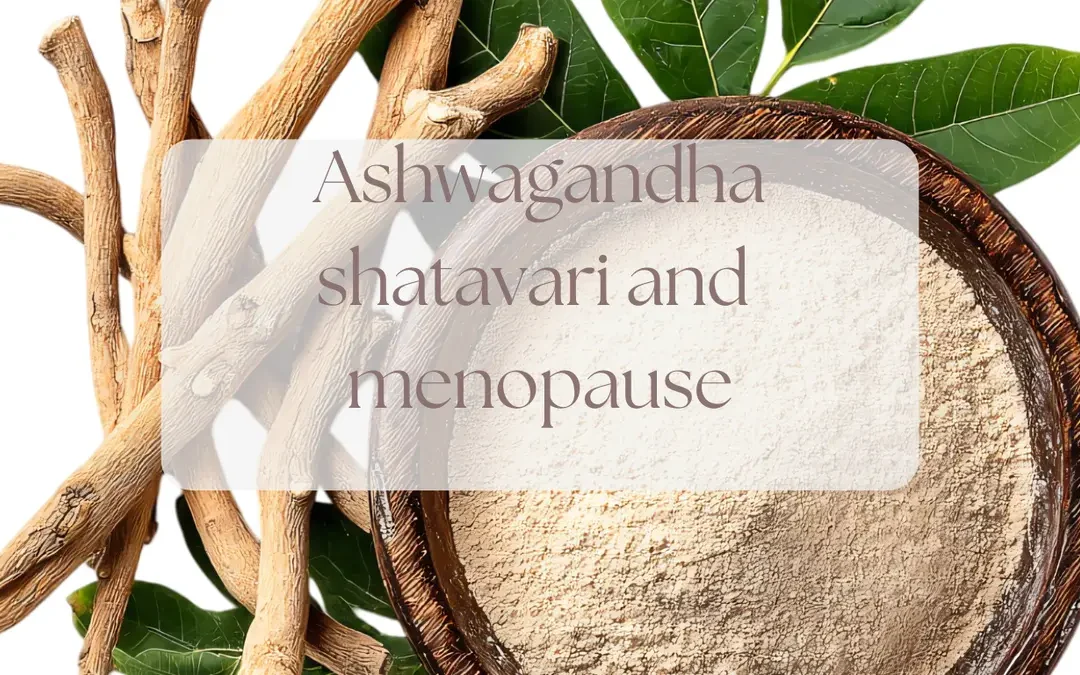
For most of the last century, a woman in menopause had two options presented to her: hormone therapy, or endure it. Ayurveda, the traditional medicine of India, always had a third conversation, and at the center of it sat two herbs, ashwagandha and shatavari. They were prescribed together for this stage of a woman's life centuries before anyone could measure why. In 2025 a randomized, placebo-controlled trial put that exact pairing to the test, and the results are worth understanding clearly, because they are genuinely encouraging and also easy to overstate. Timing matters more than most people think: whether to take ashwagandha in the morning or at night.
The two herbs Ayurveda has always paired for this stage
Ashwagandha (Withania somnifera) and shatavari (Asparagus racemosus) do different jobs, which is exactly why they are given together. Ashwagandha is the grounding, steadying herb, classically used to calm an overactive nervous system and support resilience under stress. Shatavari is the cooling, nourishing herb, the one Ayurveda has long associated with the female reproductive system across every stage from fertility to menopause. One settles, the other replenishes.
Menopause, read through this lens, is not a disease to be corrected. It is a transition in which the vata quality rises, bringing dryness, restlessness, and disturbed sleep, often layered over heat and irritability. A grounding herb and a cooling, moistening one address that picture from two directions at once. This is the logic the tradition has followed for generations, and it is the pairing the 2025 study set out to examine.
What the 2025 trial actually tested
The study was published in the Journal of Menopausal Medicine and was built the way good evidence should be: randomized, double-blind, and placebo-controlled, which means neither the women nor the researchers knew who received the herbs and who received a dummy. It looked at standardized extracts of shatavari, ashwagandha, and the two in combination, in postmenopausal women, and it measured more than how people said they felt.
Alongside a validated menopause quality-of-life questionnaire, the researchers tracked markers you cannot talk yourself into: measures of vascular function and a marker of bone resorption, the process by which bone is broken down. That matters, because two of the least visible risks of menopause are to the blood vessels and the skeleton. A trial that measures those is asking a more serious question than one that only asks whether hot flashes eased.
What it found: symptoms, blood vessels, and bone
The headline result is that the extracts reduced menopausal symptoms, improved measures of vascular dysfunction, and lowered bone resorption, and that they did so in a dose-dependent way. Dose-dependent is the phrase that gives a finding weight: more herb produced more effect, which is the pattern you expect from something that is genuinely acting on the body rather than appearing to work by chance. The combination was examined precisely because Ayurveda predicts these two herbs do more together than either alone.
It is worth being honest about scale. This is one well-designed trial, not decades of accumulated data, and the women studied were postmenopausal rather than every stage of the transition. What it establishes is not a miracle and not a replacement for medical care. It is credible, measurable support from two herbs a tradition has recommended for exactly this, now tested against a placebo and holding up. That is a meaningful thing to be able to say, and it is enough.
Ashwagandha and shatavari in menopause: why Ayurveda pairs them
In Ayurvedic terms both herbs belong to a category called rasayana, roughly translated as rejuvenating or restorative, the medicines used to rebuild the deeper tissues and vitality rather than to suppress a symptom. Ashwagandha is prized for steadying the nervous system, which is why it maps so well onto the sleeplessness and anxiety of this stage. Shatavari is the classic tonic for the female system, cooling and moistening in a body that is trending dry and hot. Read that way, the trial's three targets line up almost too neatly with what the tradition claims: the nervous system, the vessels, and the structural tissue of bone.
None of this means you should treat the herbs as interchangeable with a prescription, or self-prescribe them at high doses because a study was positive. The tradition never used them as isolated pills. It used them inside a plan, chosen for the person, which is the part no supplement bottle can give you and the part that matters most.
A herb that a tradition prescribed for centuries, now tested against a placebo and holding up, is not a miracle. It is exactly what good evidence for an old medicine should look like.
How to use this without turning it into a pill
The temptation with a positive study is to buy the herb and treat it as a fix, which quietly repeats the very mistake Ayurveda was built to avoid. These herbs work best as part of the wider picture of this stage: steady sleep, warm and grounding food, movement that suits your energy, and a nervous system that is not permanently braced. I write about that fuller picture in my article on menopause and Ayurveda, and on hormonal health more broadly.
Dose, quality of extract, and whether these herbs suit your particular constitution are not one-size questions, and they matter more with menopause than with almost anything else, because this is also a stage with real medical considerations. Ashwagandha is not right for everyone, and herbs interact with conditions and medications. The sensible path is to use a study like this as a reason to have an informed conversation, with a practitioner and with your doctor, not as a reason to skip one.
The honest takeaway
Here is what the 2025 trial lets you say with a straight face. Two herbs that Ayurveda has paired for menopause for centuries were tested properly and reduced symptoms while also improving markers in the blood vessels and bone, more so at higher doses. That is real support, grounded in evidence, for an approach that treats menopause as a transition to be supported rather than only a problem to be medicated.
What it does not do is hand you a pill to take alone. The herbs were always meant to sit inside a plan built around your body and your stage of life. Used that way, ashwagandha and shatavari are a genuinely useful part of the toolkit. Used as a shortcut, they are just another bottle on the shelf.
Whether these herbs suit you depends on your constitution. Take my free Ayurvedic dosha test to understand your type, or book an ayurveda online consultation for a plan built around your stage of menopause.
Source: Journal of Menopausal Medicine, 2025 — DOI: 10.6118/jmm.24025. Ashwagandha and shatavari extracts and menopause symptoms, vascular function and bone resorption; randomized, double-blind, placebo-controlled study. This article is for informational purposes and does not replace consultation with a healthcare professional. Do not start herbal supplements without professional guidance, particularly alongside existing conditions or medications.